
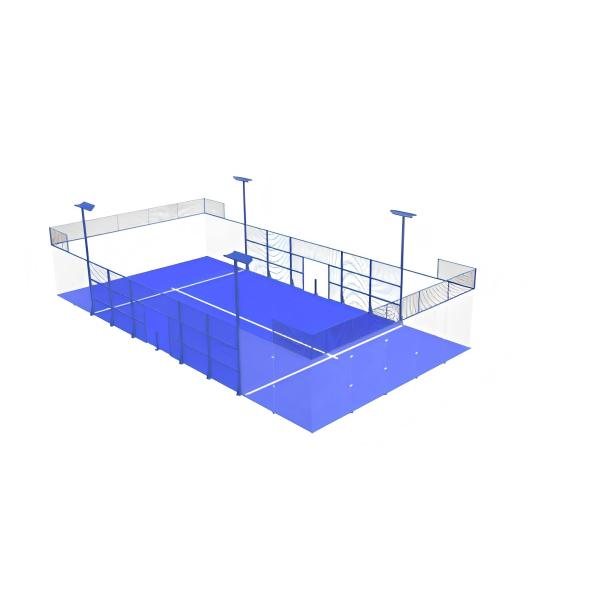
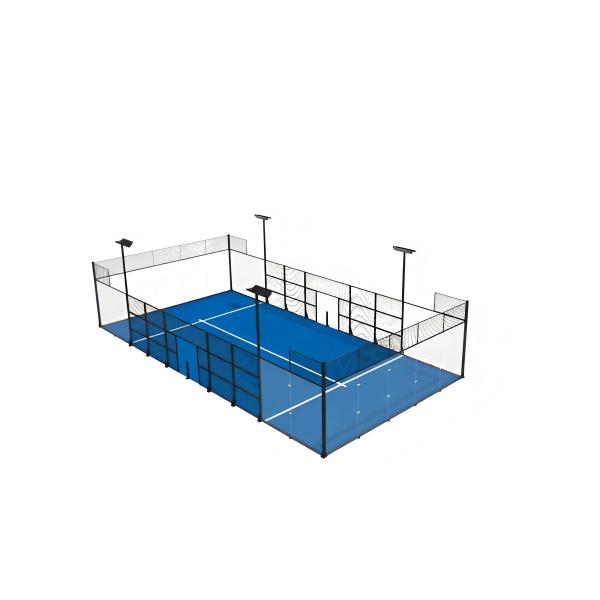
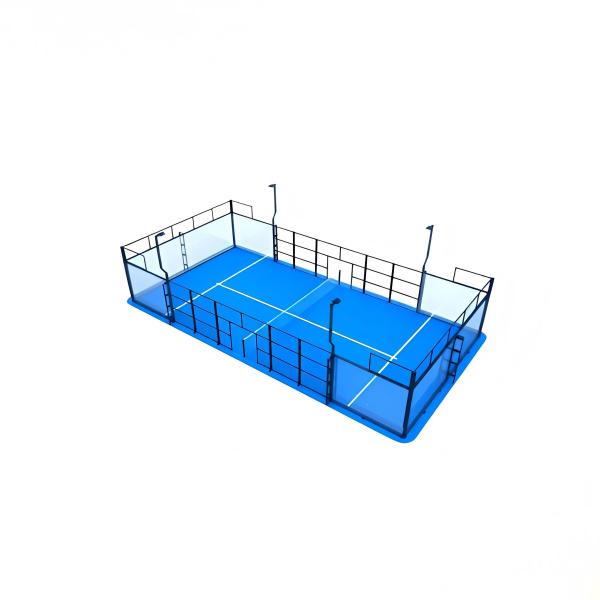
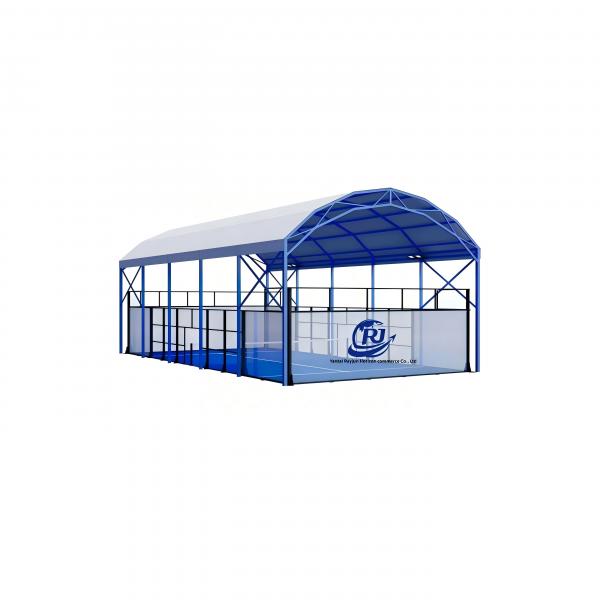
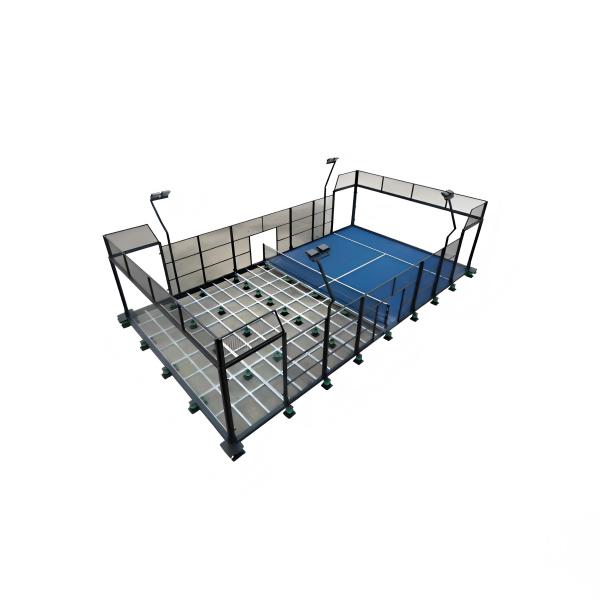
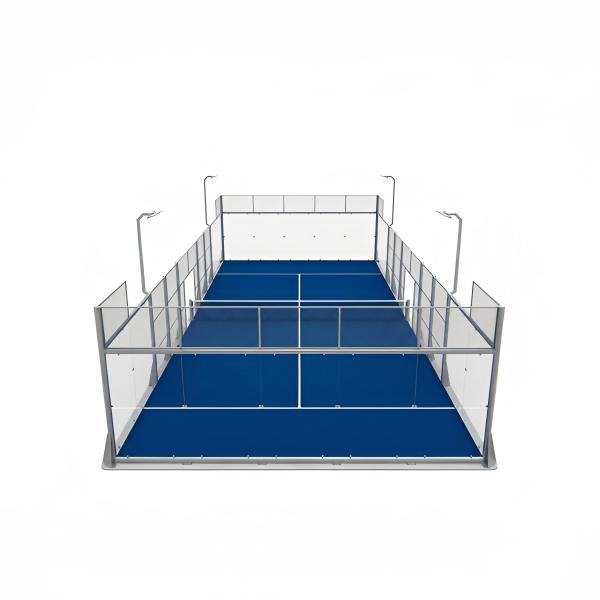
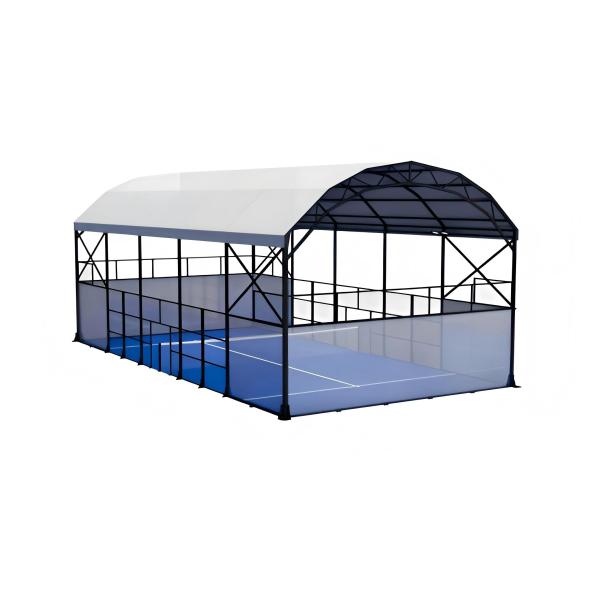
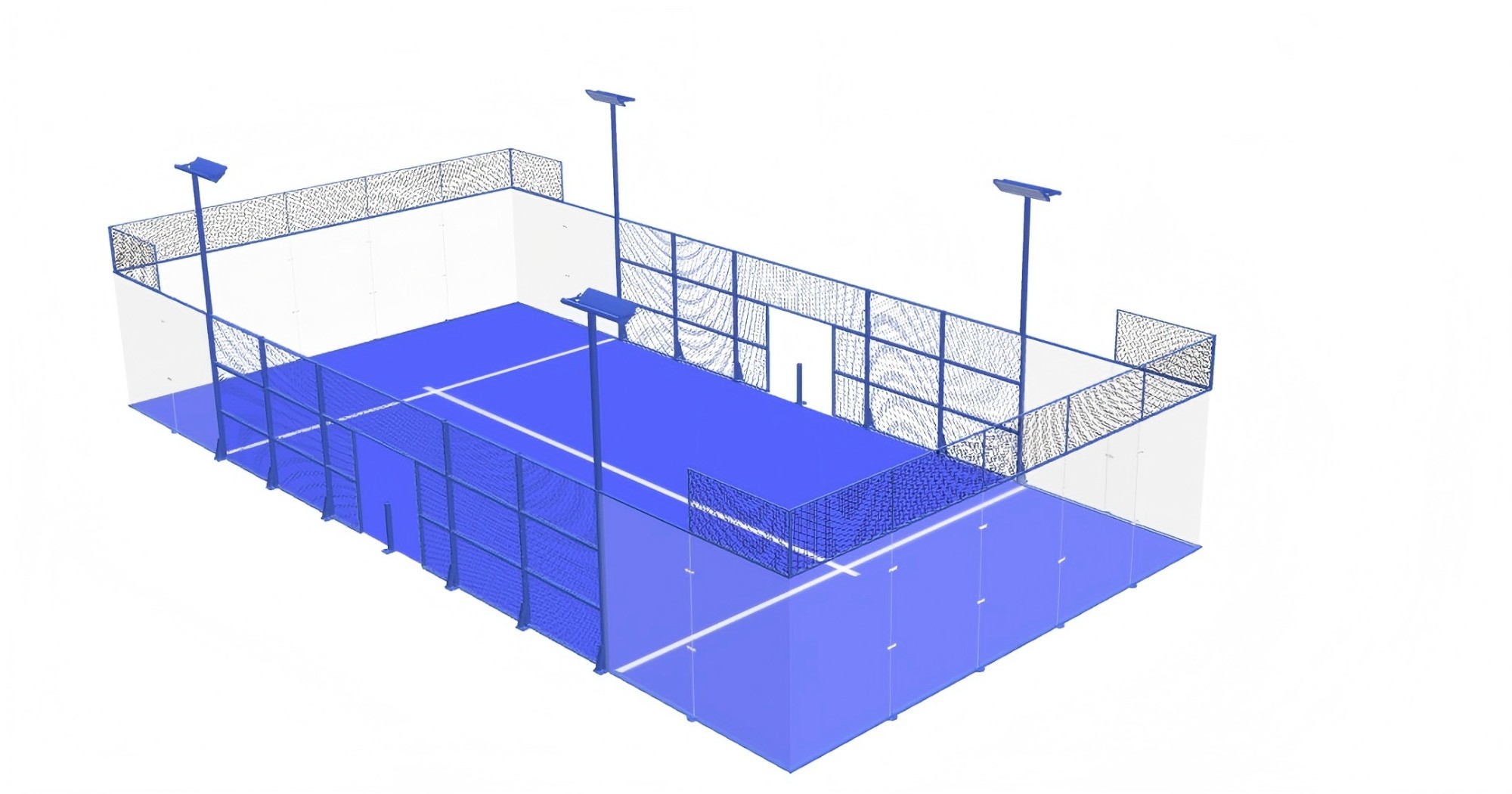
A Super Panoramic Padel Court is designed for projects that require premium appearance, unobstructed viewing and professional playing performance. By removing conventional corner posts around the main glass viewing area, it creates a cleaner and more open environment for players, spectators, tournaments and live broadcasts.
However, choosing a super panoramic model involves more than comparing appearance and price. Buyers must also evaluate structural strength, glass quality, corrosion protection, foundation conditions, artificial turf, lighting, installation and local environmental loads.
This guide explains the main purchasing considerations and practical project tips for clubs, resorts, sports centers and commercial padel developments.
What Is a Super Panoramic Padel Court?
A Super Panoramic Padel Court is an upgraded panoramic court with fewer visible steel supports around the glass walls. The open design provides wider sightlines and a more modern appearance than a standard panoramic court.
Rayjun’s standard Super Panoramic Padel Court has a 10 × 20 m playing area, a Q235 steel structure and customizable colors and accessories. It is designed for professional clubs, tournament venues, sports academies, resorts and high-end commercial facilities.
Its main benefits include:
-
Unobstructed spectator views
-
Modern, premium appearance
-
Improved conditions for photography and broadcasting
-
Clearer player visibility
-
Strong commercial branding potential
-
Professional tournament presentation
Super Panoramic vs. Standard Panoramic Padel Court
Both court types use tempered glass, steel structures, artificial turf and mesh enclosures. The main differences are structural appearance, viewing experience and project positioning.
| Comparison | Panoramic Court | Super Panoramic Padel Court |
|---|---|---|
| Glass viewing area | Some structural supports remain | Maximum open visibility |
| Visual appearance | Modern and practical | Premium and minimalist |
| Typical projects | Clubs, schools and training centers | Tournaments and flagship clubs |
| Structural requirements | Standard reinforced structure | More advanced structural design |
| Installation tolerance | Relatively flexible | Requires greater installation accuracy |
| Investment level | More economical | Higher initial investment |
| Commercial positioning | General commercial use | Premium and professional use |
A standard panoramic court is often suitable for cost-controlled multi-court developments. A Super Panoramic Padel Court is more appropriate when appearance, event use, spectator experience and premium positioning are important.
1. Start with the Project Location
Before requesting a quotation, buyers should provide the exact installation location. Structural requirements can vary significantly according to the local environment.
Important site information includes:
-
Country and city
-
Indoor or outdoor installation
-
Local wind speed
-
Snow load, where applicable
-
Distance from the sea
-
Ground or rooftop location
-
Soil and drainage conditions
-
Available installation area
-
Local building regulations
An indoor court generally has lower exposure to wind, rain and corrosion. Outdoor courts require more attention to wind loads, drainage, galvanizing and coating protection.
Coastal projects may also require enhanced anti-corrosion treatment because of salt, humidity and continuous outdoor exposure.
2. Evaluate the Steel Structure
The reduced number of visible supports is the main advantage of a Super Panoramic Padel Court, but it also places greater demands on structural engineering.
Buyers should evaluate:
-
Steel material and tube dimensions
-
Column and beam reinforcement
-
Weld quality
-
Connection design
-
Base plate thickness
-
Bolt and fastener quality
-
Wind-load calculations
-
Surface treatment
-
Manufacturing tolerances
The structure must control movement around the large glass viewing area while safely transferring loads into the base plates, anchors and foundation.
Do not evaluate a court based only on steel weight. A reliable structure depends on the complete design, including steel sections, connections, anchoring and foundation conditions.
Project Tip
Ask the supplier to provide a structural layout and confirm whether the proposed model is suitable for the project’s local wind conditions. For exposed outdoor sites, consider a dedicated Wind Resistant Padel Court rather than using a standard structure without additional engineering.
3. Check the Anti-Corrosion Treatment
Outdoor padel courts are continuously exposed to rain, humidity, sunlight and temperature changes. Poor surface protection can lead to rust around welds, bolts, mesh panels and base plates.
A durable outdoor structure normally uses:
-
Galvanized steel
-
Proper surface cleaning or shot blasting
-
Outdoor-grade powder coating
-
Protected welds and cut edges
-
Corrosion-resistant fasteners
Rayjun uses reinforced steel structures with hot-dip galvanizing and powder coating for outdoor durability.
Project Tip
For coastal projects, tell the manufacturer how far the site is from the sea. Standard outdoor coating may not provide the same service life in a high-salt environment.
The maintenance plan should also include regular cleaning and prompt repair of scratched coating.
4. Confirm the Tempered Glass System
The glass walls are both part of the enclosure and an active playing surface. Glass quality and installation accuracy directly affect safety, visibility and ball rebound.
Buyers should confirm:
-
Glass thickness
-
Tempering standard
-
Edge finishing
-
Hole position accuracy
-
Panel dimensions
-
Protective gaskets
-
Stainless-steel or protected fasteners
-
Replacement glass availability
-
Export packaging method
The supporting structure and glass holes must align accurately. Incorrect installation, uneven support or excessive tightening may create concentrated stress around the fixing points.
Project Tip
Order at least one replacement glass panel for remote or multi-court projects. Shipping one replacement panel separately can be expensive and may cause long operational delays.
The glass should be packed in reinforced export crates and clearly labeled according to its installation position.
5. Select the Right Artificial Turf
Artificial turf affects ball speed, bounce, traction, player comfort and maintenance requirements.
The main selection factors include:
-
Textured or fibrillated yarn
-
Pile height
-
Yarn density
-
Sand requirement
-
UV resistance
-
Color
-
Drainage
-
Intended playing level
Textured turf generally keeps the sand more evenly distributed and may require less visible maintenance. Fibrillated turf is widely used and can provide a practical balance between performance and project cost.
Popular colors include:
-
Blue
-
Green
-
Black
-
Red
-
Customized club colors
Project Tip
Choose the turf according to the intended users rather than appearance alone. A tournament court, training academy and recreational hotel court may require different playing speeds and maintenance levels.
Ask the supplier for turf specifications and installation instructions before confirming the order.
6. Plan the Foundation and Drainage Early
A high-quality court cannot compensate for an uneven or poorly prepared foundation.
The concrete base should provide:
-
Correct dimensions
-
Adequate load-bearing capacity
-
Accurate anchor positions
-
A level playing surface
-
Effective drainage
-
Safe cable routes
-
Sufficient space around the court
An uneven foundation can create problems during steel assembly and glass installation. Standing water can also shorten turf life and increase corrosion around the lower steel structure.
Project Tip
Complete the foundation drawings before beginning civil construction. Do not allow the local contractor to estimate anchor positions without referring to the court supplier’s final layout.
For rooftop projects, a qualified local structural engineer should verify:
-
Building load capacity
-
Wind exposure
-
Waterproofing
-
Drainage
-
Anchoring method
-
Access for glass and steel components
Where permanent foundations are not possible, a Temporary Padel Court or foundation-free platform system may be more appropriate.
7. Choose a Suitable Lighting System
Lighting influences court utilization, player comfort and operating revenue. Poorly positioned fixtures can create glare, dark areas and distracting shadows.
Buyers should consider:
-
Recreational or competition use
-
Required illumination level
-
Indoor or outdoor installation
-
Fixture power
-
Beam angle
-
Pole position
-
Glare control
-
Electrical voltage
-
Local electrical standards
-
Maintenance access
The lighting layout should be coordinated with the steel structure before production. This allows mounting plates, cable routes and connection points to be prepared correctly.
Project Tip
Request a lighting layout for the complete project, especially when installing several courts. Lighting should also consider walkways, entrances, seating areas and neighboring properties.
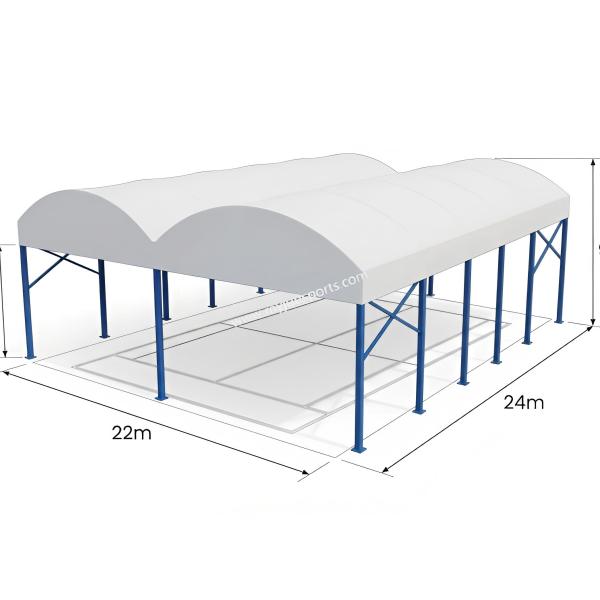
For locations with frequent rain or strong sunlight, an Integrated Roof Padel Court can help provide more consistent operating conditions.
8. Consider Player and Spectator Movement
The court itself occupies 10 × 20 m, but the complete project requires additional space.
Allow room for:
-
Court entrances
-
Player waiting areas
-
Benches
-
Spectator circulation
-
Equipment storage
-
Emergency access
-
Maintenance access
-
Lighting and electrical equipment
-
Reception and changing facilities
For multi-court projects, sufficient distance should be maintained between courts so that doors, players and maintenance personnel can move safely.
A super panoramic design is particularly valuable when spectators, cameras or hospitality areas are positioned behind the glass.
Project Tip
Plan the court orientation carefully. Sunlight direction, prevailing wind and spectator positions can affect both the playing and viewing experience.
9. Review What Is Included in the Quotation
A low court price may exclude important components or services.
Before comparing suppliers, confirm whether the quotation includes:
-
Steel structure
-
Mesh panels
-
Tempered glass
-
Artificial turf
-
Turf adhesive and joining tape
-
Silica sand
-
Net and posts
-
LED lighting
-
Fasteners and glass fittings
-
Doors and handles
-
Protective padding
-
Spare parts
-
Export packaging
-
Shipping
-
Installation supervision
-
Foundation drawings
Also confirm which items must be sourced locally. Concrete, electrical cables, lifting equipment, local labor and installation tools are often not included in the exported court package.
Project Tip
Compare the complete delivered and installed cost rather than the factory price alone. Freight, civil construction, customs clearance, local transport and installation can represent a significant part of the total project investment.
10. Prepare for Shipping and Installation
A Super Panoramic Padel Court contains long steel components, heavy glass panels, turf rolls and many small accessories. Clear packing and component identification can significantly improve installation efficiency.
Ask the supplier about:
-
Container loading plan
-
Glass crate design
-
Package labeling
-
Component list
-
Installation sequence
-
Required tools
-
Lifting requirements
-
Installation manual
-
Video guidance
-
Remote technical support
Rayjun provides complete court system integration, including structures, flooring, lighting, nets and optional roof systems.
Project Tip
Do not open all packages at the beginning of installation. Open components according to the assembly sequence to reduce surface damage, misplaced fasteners and site confusion.
Store glass vertically on stable supports and keep turf protected from water and construction debris.
Common Buying Mistakes to Avoid
Choosing by Price Alone
A cheaper court may use thinner steel, lower-quality coating, basic glass packaging or incomplete accessories. These savings may create higher installation and maintenance costs.
Ignoring Local Wind Conditions
The visual design may be suitable, but the standard structure may not be appropriate for an exposed coastal, island or rooftop site.
Starting the Foundation Too Early
Civil work should begin only after the final court drawings, anchor layout and drainage plan have been confirmed.
Forgetting Shipping and Installation Costs
The court price is only one part of the total investment. Buyers should budget for freight, duties, concrete, labor, lifting equipment and electrical work.
Using Unqualified Installers
Super panoramic structures require accurate alignment. Installation errors can affect glass fitting, door operation, structural stability and playing performance.
Ordering Without Spare Parts
Glass fittings, bolts, turf materials, lighting components and replacement glass should be considered before shipment, especially for projects far from the supplier.
Information to Send to the Manufacturer
To receive an accurate proposal, prepare the following information:
-
Installation country and city
-
Number of courts
-
Indoor or outdoor installation
-
Ground-level or rooftop project
-
Available site dimensions
-
Local wind and snow conditions
-
Distance from the coastline
-
Preferred turf color
-
Lighting requirements
-
Roof or canopy requirements
-
Expected installation date
-
Destination port or delivery address
Providing complete information allows the manufacturer to recommend a suitable structure, prepare a more accurate quotation and reduce changes during production.
Is a Super Panoramic Padel Court Right for Your Project?
A Super Panoramic Padel Court is a strong choice when the project requires:
-
Premium club positioning
-
Tournament-level presentation
-
Unobstructed spectator views
-
Professional photography or broadcasting
-
Strong visual branding
-
A flagship court for a multi-court club
-
A modern design for hotels or resorts
A standard panoramic court may be more economical for schools, community centers and large multi-court developments focused primarily on recreational use.
Many commercial clubs combine both models: super panoramic courts for central show courts and standard panoramic courts for training and daily bookings.
Work with an Experienced Padel Court Manufacturer
A successful padel project requires coordination between court design, civil engineering, manufacturing, shipping and installation.
Rayjun supplies Super Panoramic Padel Courts with customizable steel colors, turf, lighting, net systems and optional roof solutions. Project support can include court selection, technical drawings, export packaging and installation guidance.
To receive a project proposal, send us your installation location, court quantity, site dimensions and environmental conditions.
Request a Super Panoramic Padel Court quotation, technical drawings and project configuration today.